Why Calorie Tracking Feels Tedious — and the Effortless Fix

You start strong. The first few days of calorie tracking feel almost satisfying — you finally know what you're eating. Then it creeps in: searching the database for the right cup of rice, deciding whether your chicken thigh is "with skin" or "without," weighing the pasta, second-guessing the portion. By week two it's a chore, and by week three you've quietly stopped. If calorie tracking feels tedious to you, you're not lazy and you're not alone — the tedium is built into the way most apps make you do it. The good news is that the friction, not the tracking itself, is the problem — and once you remove it, the easiest way to track calories turns out to be simply logging the way you already eat.
This isn't a willpower issue. It's a design issue. Let's name exactly what burns people out, why it matters more than precision, and how logging the way you actually eat makes the whole thing effortless enough to keep.
Why traditional calorie tracking burns you out
The classic calorie-tracking flow is a series of tiny frictions that pile up until the whole thing collapses. Each one seems small. Together, they're exhausting:
- Manual database search. Every meal means typing a food name, scrolling through a list of near-identical entries, and guessing which "grilled chicken breast" is the right one. Dozens of times a day, this adds up fast.
- Weighing and measuring. Pulling out a food scale, weighing each component, and converting to grams turns a five-minute meal into a logging project. Most people won't do it at a restaurant, at a friend's place, or on a busy Tuesday — so they don't log at all.
- Decision fatigue. Cup or gram? Cooked or raw weight? Which brand? Each tiny choice taxes your attention, and by dinner you're out of patience.
- All-or-nothing thinking. Miss one meal and the day's log has a hole in it. That hole feels like failure, the failure feels like permission to stop, and one skipped lunch becomes a quit. The format practically invites you to give up.
Notice that none of these are about the idea of tracking. They're about the labor of tracking. The concept is sound; the workflow is the thing grinding you down.
The friction is the real problem
Here's the insight that changes everything: for weight loss, consistency beats precision — and it isn't close. An app that's perfectly accurate but so tedious you log half your meals gives you a record full of holes. A log with gaps is genuinely misleading, because the meals you skip are usually the ones you'd least like to face. Meanwhile, an app that's roughly right but so easy you log everything gives you a complete, honest picture you can actually act on.
Think about what actually drives results. Weight change follows your trend over weeks, not the exact calorie count of any single lunch. A small, random error on every meal mostly washes out over time. A missing meal does not — it's a one-directional gap that quietly breaks your numbers. So the most valuable property a tracker can have isn't accuracy to the gram. It's being effortless enough that you never skip. The "perfect" tool you abandon loses to the "good enough" tool you keep, every time. We dig into why a 15% estimate is plenty in can AI really count calories from a photo.
The easiest way to track calories: log the way you actually eat
The fix is to stop bending your life around the app and make the app fit how you already eat. Modern AI trackers let you log a meal in seconds, three ways, so you always have a path of least resistance:
- Snap a photo. Point your phone at the plate and the AI identifies the food and estimates the portions — no search, no scale. Perfect for a real meal in front of you. Here's a step-by-step on doing it well: count calories from a photo.
- Say it out loud. "A bowl of oatmeal with blueberries and a spoon of almond butter." Voice is often the single fastest way to log — faster than typing, faster than photographing — especially for simple meals.
- Quick text or barcode. Type a one-line description when you can't talk, or scan a barcode for an exact, label-accurate entry on anything packaged.
The point isn't any one method — it's that you always have the fastest one available for the situation. Photo for a restaurant plate, voice for a quick snack, barcode for the protein bar. When logging takes five seconds instead of two minutes, the all-or-nothing trap disappears, because there's no longer a reason to skip.
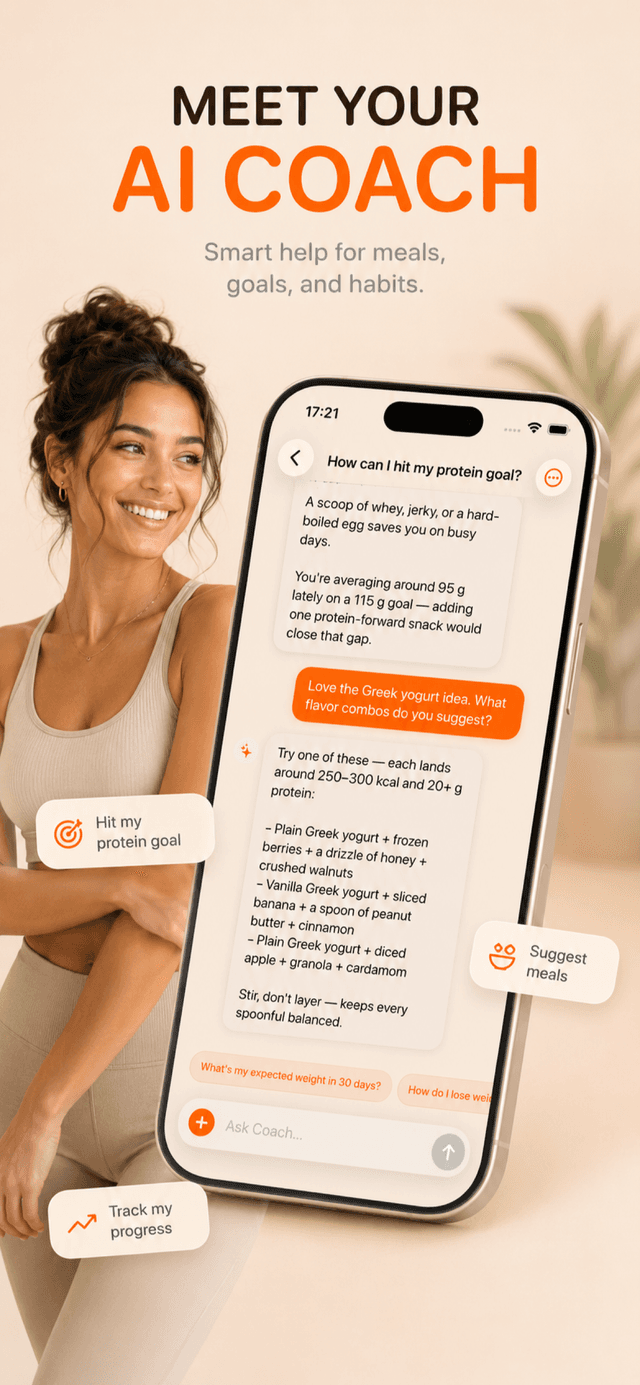
It also helps to have something on your side when you're unsure. Voidpen's AI Coach is a chat you can ask "is this estimate reasonable?" or "what should I swap to stay under my calories tonight?" — so a moment of doubt becomes a quick answer instead of a reason to close the app. That, too, is friction removed.
How to track calories without weighing food
You don't need a food scale to track effectively. You need habits that get you close, fast, without the friction that makes you quit. Here's how to track calories without weighing anything:
- Use visual portion references. A serving of protein is roughly the size of your palm; a cup of rice or pasta is about a clenched fist; a thumb is roughly a tablespoon of fats like oil, butter, or nut butter. These mental yardsticks are surprisingly reliable and always with you.
- Let AI estimate the portion for you. A photo-based tracker sizes the plate so you don't have to. It won't be exact, but it's typically within about ±15% — far better than most people's mental math, and good enough to guide your eating.
- Keep every number editable. The fastest workflow is to accept the AI's estimate and only adjust when something's clearly off — a generous pour of oil, a portion bigger than it looks. In Voidpen every estimate is editable in a couple of taps, so you correct what matters and ignore what doesn't.
- Don't sweat the small stuff. A few calories here or there won't change your trend. Capturing the meal at all is what counts.
Tracking doesn't have to be a chore, and it definitely doesn't require a scale. When the act of logging is genuinely effortless, you stop quitting — and consistency is the whole game. If you're ready to put a real number on your goal, here's how many calories to lose weight. Get the target right, make the logging effortless, and the results take care of themselves.